The Great AI Transition 2025 → 2026: 15 AI Tools Replacing Traditional Software for Productivity, Research, Design, and Business
Discover how AI is transforming productivity in 2026. Learn why tools like Claude, Perplexity, Cursor, Gamma, Replit, and NotebookLM are replacing traditional software such as Google Search, Photoshop, PowerPoint, and VS Code.
Understanding the AI Workflow Revolution
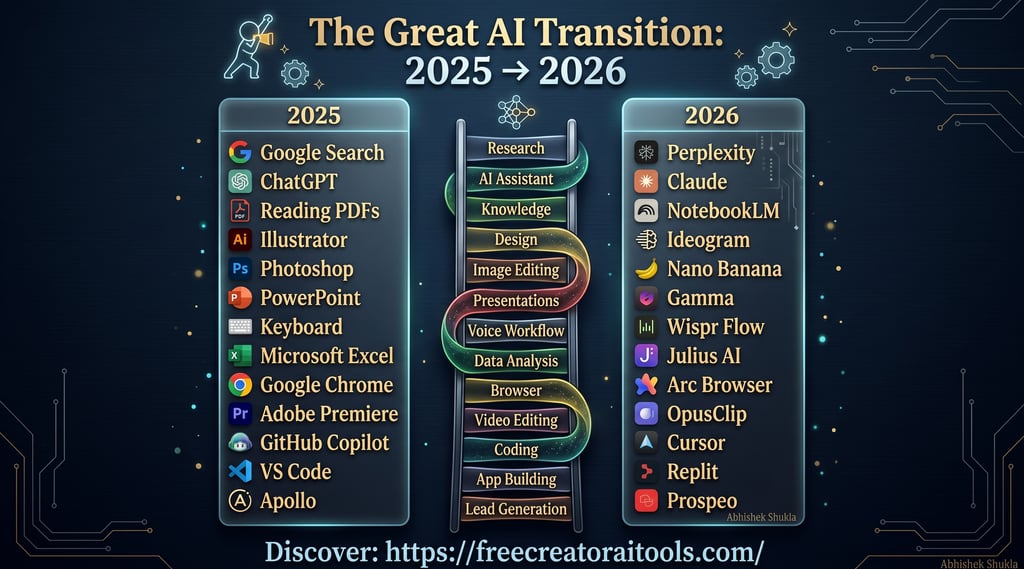
The image compares commonly used tools in 2025 with emerging AI-powered alternatives dominating workflows in 2026.
The ladder in the center represents various work functions:
Research
AI Assistance
Knowledge Management
Design
Image Editing
Presentations
Voice Workflow
Data Analysis
Browsing
Video Editing
Coding
App Building
Lead Generation
Instead of switching between multiple applications, AI platforms now handle many of these tasks from a single interface.
1. Search is Evolving: Google Search → Perplexity
Why Perplexity is Gaining Popularity
Traditional search engines provide links.
Perplexity provides answers.
Instead of opening multiple websites and reading articles manually, users receive:
Direct answers
Source citations
AI-generated summaries
Follow-up questions
Deep research capabilities
Benefits
✔ Faster research
✔ Reduced information overload
✔ Better productivity
Keywords
Perplexity AI
AI search engine
Google Search alternative
AI research tools
2. ChatGPT → Claude for Long-Form Reasoning
While ChatGPT remains a leading AI assistant, Claude has become popular for:
Long documents
Deep analysis
Strategic planning
Research synthesis
Extended context windows
Professionals increasingly use Claude for:
Business reports
Ebooks
Market research
Academic work
Content creation
Keywords
Claude AI
AI writing assistant
Long-form AI writing
AI research assistant
3. PDF Reading → NotebookLM
Reading hundreds of pages manually is becoming less common.
NotebookLM allows users to:
Upload PDFs
Ask questions
Generate summaries
Create study guides
Extract key insights
Use Cases
Students
Researchers
Consultants
Content creators
Keywords
NotebookLM
AI PDF summarizer
AI knowledge management
Study with AI
4. Illustrator and Photoshop → Ideogram
Design workflows are changing rapidly.
Ideogram enables users to create:
Logos
Social media graphics
Marketing visuals
Pinterest pins
Digital product covers
without advanced design skills.
Advantages
✔ AI-generated typography
✔ High-quality graphics
✔ Fast design generation
Keywords
Ideogram AI
AI image generator
AI graphic design
AI logo creator
5. PowerPoint → Gamma
Creating presentations traditionally required hours of manual work.
Gamma transforms a simple prompt into:
Professional presentations
Business reports
Interactive documents
Visual storytelling decks
Why Businesses Love Gamma
Faster creation
Better visuals
AI-powered layouts
Keywords
Gamma AI
AI presentation maker
PowerPoint alternative
AI slides generator
6. Excel → Julius AI
Data analysis is becoming conversational.
Instead of creating formulas manually, users can ask:
"Analyze this dataset and show trends."
Julius AI can:
Analyze spreadsheets
Create charts
Generate insights
Perform forecasting
Keywords
Julius AI
AI data analysis
Excel alternative
AI spreadsheet tools
7. Chrome → Arc Browser
Browsers are becoming intelligent workspaces.
Arc Browser focuses on:
Productivity
Organization
AI integration
Modern workflow management
Many users consider it the future of web browsing.
Keywords
Arc Browser
Productivity browser
AI browser
Browser for professionals
8. Premiere Pro → OpusClip
Video creators are increasingly using OpusClip to transform long videos into viral short-form content.
Features
Automatic clipping
Viral segment detection
Captions
Social media optimization
Perfect For
YouTubers
Coaches
Marketers
Agencies
Keywords
OpusClip
AI video editor
YouTube Shorts tool
TikTok content creator
9. VS Code and GitHub Copilot → Cursor
Cursor is becoming one of the fastest-growing AI coding environments.
Developers use it for:
Code generation
Debugging
Refactoring
Full project development
Benefits
✔ Faster coding
✔ AI-powered development
✔ Enhanced productivity
Keywords
Cursor AI
AI coding assistant
AI developer tools
Programming with AI
10. App Development → Replit
Replit allows users to build applications directly from prompts.
This lowers the barrier for:
Entrepreneurs
Startups
Freelancers
Non-technical founders
Keywords
Replit AI
No-code app builder
AI app development
Build apps with AI
11. Lead Generation → Prospeo
Sales teams increasingly rely on AI-powered prospecting tools.
Prospeo helps businesses:
Find leads
Verify emails
Build outreach lists
Scale prospecting campaigns
Keywords
Prospeo
Lead generation software
AI sales tools
Email finder
What This AI Transition Means for Businesses
The shift from traditional software to AI-powered workflows is accelerating.
Companies that adopt AI tools can:
Reduce operational costs
Increase productivity
Automate repetitive tasks
Improve decision-making
Scale faster
The winners of 2026 will not necessarily be those with the largest teams, but those who leverage AI most effectively.
Final Thoughts
The image captures a broader trend affecting nearly every industry. Search, design, coding, presentations, data analysis, and lead generation are all being transformed by AI.
While traditional tools remain relevant, the future belongs to AI-first platforms that combine multiple functions into intelligent, conversational workflows.
Whether you're a creator, entrepreneur, marketer, student, or developer, understanding this transition now may provide a significant competitive advantage over the next few years.
The Great AI Transition: From Traditional Software to AI-First Workflows
The image above illustrates one of the biggest technological shifts happening today: the transition from traditional software tools in 2025 to AI-powered platforms in 2026.
For years, professionals relied on separate applications for research, writing, design, coding, presentations, and data analysis. Today, AI tools are consolidating these tasks into intelligent systems that work faster, automate repetitive processes, and significantly increase productivity.
This transition is not merely about replacing software—it represents a complete transformation in how individuals and businesses work.